13 févr. 2024
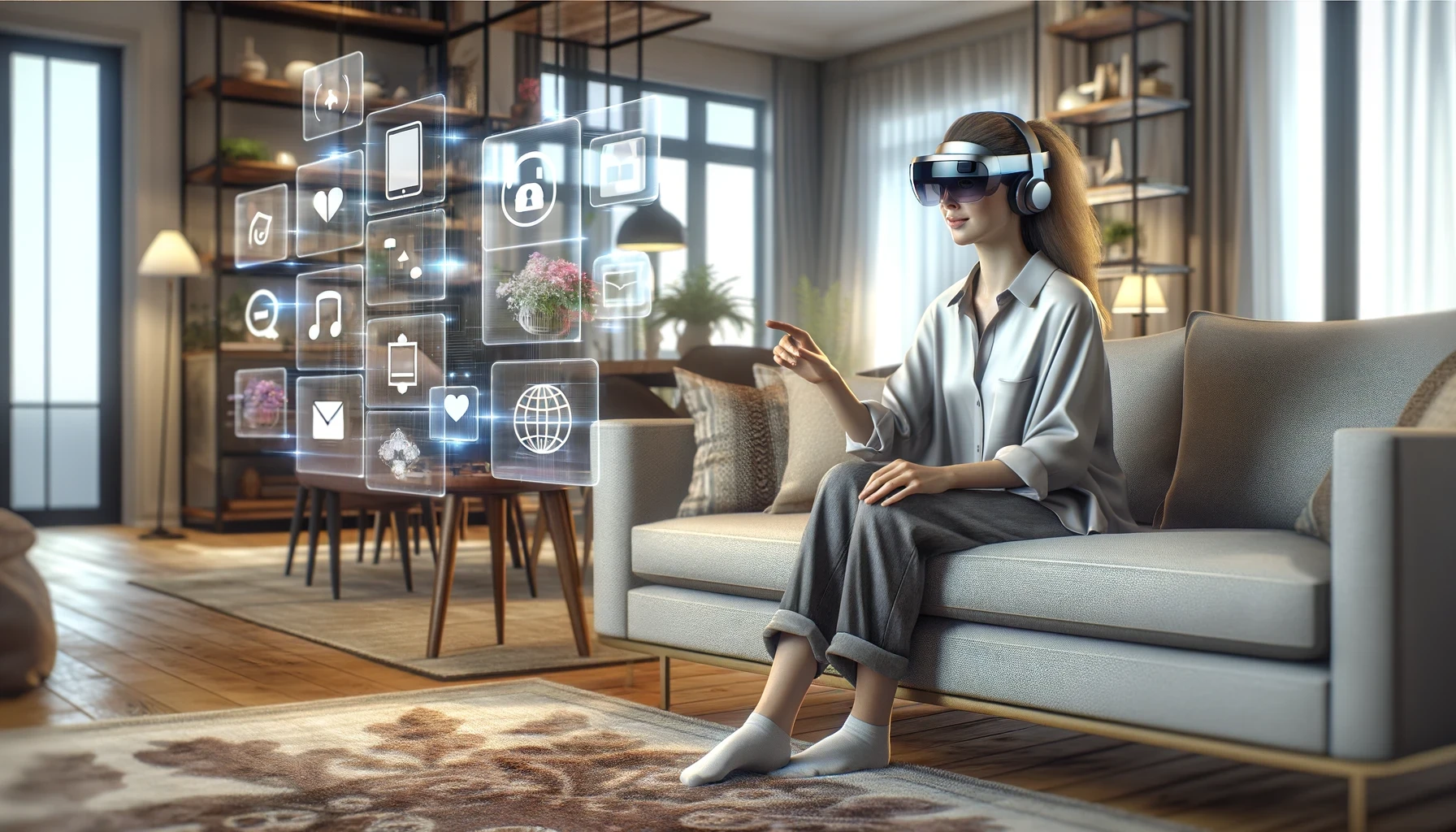
Spatial computing represents a transformative leap in how we interact with digital information, marking the convergence of our physical and digital worlds. Enabled by a trio of groundbreaking technologies—Augmented Reality (AR), Virtual Reality (VR), and Mixed Reality (MR)—spatial computing allows users to manipulate and interact with digital objects in a three-dimensional space as if they were physical entities. This interaction is not confined to a screen or a single point of interaction; it encompasses the entire environment around the user, making digital content an integral part of our physical surroundings.
The essence of spatial computing lies in its ability to blend the digital with the real, creating experiences where virtual objects possess a presence and can interact with the physical world in real-time. From overlaying digital information onto the real world in AR to immersing users completely in a digital environment in VR, and seamlessly blending real and virtual worlds in MR, spatial computing offers a spectrum of experiences that are transforming industries. In healthcare, it's used for advanced surgical simulations and patient education; in entertainment, it's creating immersive gaming and storytelling experiences; and in education, it's providing interactive learning environments that were once unimaginable.
The historical journey of spatial computing is rich and varied, tracing back to early experiments in VR that sought to create fully immersive environments. These initial forays laid the groundwork for the development of AR and MR technologies, which sought to bring digital interactions into the real world. Over the decades, we've witnessed significant milestones that have propelled the growth of spatial computing technologies. From the development of the first head-mounted display systems to the introduction of consumer-ready VR headsets and sophisticated AR applications on smartphones, each breakthrough has expanded the possibilities of spatial computing.
The launch of devices like the Apple Vision Pro signifies a new era in spatial computing, offering advanced MR capabilities with unprecedented ease of use and accessibility. These devices are not just technological marvels but are also shaping the future of how we learn, work, and play by offering more natural and intuitive ways to interact with digital content. The evolution of spatial computing technologies reflects a journey towards more immersive, interactive, and impactful digital experiences, underlining the potential of these technologies to redefine our relationship with the digital world.
The Role of UX/UI Design in Spatial Computing
As we navigate through the realms of spatial computing, the principles of User Experience (UX) and User Interface (UI) design assume a pivotal role in crafting experiences that are not only immersive but also intuitive and engaging. The transition from traditional 2D interfaces to 3D spatial interactions marks a significant shift in how designers approach the creation of digital environments. This evolution demands a reimagining of UX/UI design principles to accommodate the complexities of user navigation and interaction within expansive three-dimensional spaces.
User-Centered Design in Spatial Environments
The core of effective spatial computing experiences lies in user-centered design. In a spatial environment, users expect to interact with digital elements as naturally as they do with physical objects in the real world. This expectation sets the bar high for UX/UI designers, who must craft experiences that seamlessly blend digital and physical realms. The principles of intuitive design, clear navigational cues, and accessible interfaces that have guided traditional 2D design must now be expanded to consider depth, scale, and spatial relationships. Designers are tasked with creating 3D interactions that are immediately understandable, requiring minimal explanation or adaptation from the user. As such, the design process must prioritize the natural movement and cognitive behaviors of users, ensuring that virtual environments feel as familiar and navigable as their physical counterparts.
Challenges of Designing for Spatial Computing
Designing for spatial computing introduces a set of unique challenges that test the limits of UX/UI design. One of the primary concerns is user comfort; spatial computing experiences, especially those in VR, can sometimes induce motion sickness or disorientation. Designers must therefore be meticulous in crafting movements and transitions that minimize discomfort, employing techniques that synchronize virtual movements with the user's physical expectations.
Another challenge lies in accommodating varying levels of user mobility. Spatial computing environments should be accessible and enjoyable for users with a wide range of physical abilities. This inclusivity requires designing interactions that are adaptable to different mobility levels, ensuring that everyone can navigate and interact with the virtual space effectively.
Furthermore, creating interactions that feel natural and intuitive in a 3D space is paramount. Unlike the flat design of traditional interfaces, spatial computing demands that designers think in all dimensions. This means considering how users will reach for, manipulate, and engage with virtual objects from different angles and distances. The design must anticipate and facilitate these interactions in a way that feels instinctive to the user, leveraging gestures, voice commands, and other natural input methods to bridge the gap between the physical and digital worlds.
In summary, the role of UX/UI design in spatial computing is both critical and complex. Designers must navigate the challenges of creating comfortable, accessible, and intuitive 3D experiences that cater to a diverse user base. By prioritizing user-centered design principles and embracing the unique possibilities of spatial interactions, designers can unlock the full potential of spatial computing to create truly transformative digital experiences.
Principles of UX/UI Design in Spatial Computing
Spatial computing has the potential to redefine our digital interactions by creating environments that are not just visually compelling but also deeply immersive and intuitively interactive. The principles of UX/UI design play a crucial role in realizing this potential, focusing on creating experiences that are accessible, engaging, and meaningful. Below are key principles that guide UX/UI design in the context of spatial computing.
Immersive Interaction Design
The goal of immersive interaction design is to create experiences that fully engage the user's senses, making the digital environment feel as real and tangible as the physical world. UX/UI designers can achieve this by strategically leveraging spatial cues, depth perception, and scale. These elements help to construct a three-dimensional space that users can navigate and interact with naturally.
Motion and animation play critical roles in enhancing the sense of immersion. They can simulate the physics of the real world, providing feedback that aligns with users' expectations based on their experiences outside the digital realm. For instance, objects in a VR application might bounce or sway in response to user interactions, mimicking real-world physics to deepen the sense of immersion.
Haptic feedback further bridges the gap between the digital and physical by providing tactile sensations that correspond to visual and auditory inputs. When a user "touches" a virtual object, haptic feedback can simulate the texture, resistance, and even temperature of that object, adding a layer of physicality to the digital interaction. This multisensory approach is essential for creating immersive experiences that fully captivate the user.
Accessibility and Inclusivity
Designing for accessibility and inclusivity is paramount in spatial computing to ensure that these advanced digital experiences are available to everyone, including people with disabilities. This principle involves creating spatial experiences that are usable for people with visual, auditory, and motor impairments, among others.
For individuals with visual impairments, designers can incorporate audio cues and voice navigation to guide users through the virtual space. For those with auditory impairments, visual signals and subtitles can provide necessary information and cues. And for users with motor impairments, alternative input methods such as eye tracking or simplified gesture controls can facilitate interaction without the need for precise movements.
Moreover, designers must consider the diversity of users from the outset, employing a user-centered design process that includes people with disabilities in user research and testing phases. This approach ensures that spatial computing applications are not only technically accessible but also genuinely usable and enjoyable for all.
Context-Aware Design
Context-aware design recognizes that the user's environment and situational context significantly impact how they interact with spatial computing applications. By designing applications that adapt to the user's immediate surroundings and conditions, UX/UI designers can create more relevant and engaging experiences.
Leveraging environmental data, such as lighting conditions, physical space constraints, and even the user's current activity, can enhance usability and engagement. For instance, a context-aware AR application could adjust its interface brightness and contrast based on ambient lighting conditions to ensure optimal visibility. Similarly, an MR application might dynamically alter its navigational cues and interaction models based on the user's physical location and the space available for movement.
By incorporating these principles into the design process, UX/UI designers can craft spatial computing experiences that are not only immersive and engaging but also accessible and responsive to the diverse needs and contexts of their users. These principles underscore the importance of a thoughtful and user-centered approach to design, ensuring that spatial computing technologies fulfill their promise to enhance our interaction with the digital world.
Best Practices in Spatial Computing UX/UI Design
Creating compelling and effective spatial computing experiences requires more than just technical skill and creativity; it demands a rigorous approach to user research, a collaborative design process, and a thoughtful consideration of ethical and privacy issues. Below are some best practices that can guide UX/UI designers in the development of spatial computing applications.
User Research and Testing
The foundation of any successful spatial computing experience lies in a deep understanding of the user. User research and testing are critical for uncovering insights into how users interact with and respond to immersive environments. This process should begin early in the design phase and continue throughout the development lifecycle, ensuring that user feedback informs each iteration of the product.
For testing usability and user satisfaction in immersive environments, methodologies such as user interviews, focus groups, and usability testing sessions equipped with eye tracking and biometric feedback can provide valuable insights. Immersive environments present unique challenges, such as navigating 3D spaces and interacting with virtual objects, making traditional usability metrics insufficient. Instead, designers should consider metrics specific to spatial computing, such as ease of navigation, interaction intuitiveness, and physical comfort. Prototyping tools that simulate immersive experiences can also be invaluable for early-stage testing, allowing designers to refine interactions before full development.
Collaboration Across Disciplines
The complexity of spatial computing experiences necessitates a collaborative approach, bringing together UX/UI designers, software developers, and subject matter experts. Each discipline contributes a critical perspective, from ensuring the technical feasibility of designs to grounding them in real-world contexts and user needs.
Successful cross-disciplinary collaboration often involves regular communication and shared understanding of project goals and user needs. Agile development practices, paired with collaborative design tools, can facilitate this process by enabling rapid iteration and feedback across teams. Examples of successful collaboration in spatial computing projects often feature a seamless integration of design and technology, such as AR applications that accurately overlay digital information on the physical world or VR training simulations that closely mimic real-life scenarios. These successes underscore the value of diverse expertise in creating spatial computing experiences that are both innovative and grounded in user reality.
Ethical Considerations and Privacy
Spatial computing raises significant ethical considerations and privacy concerns, particularly related to data collection and user surveillance. The immersive nature of these technologies means they can collect detailed information about users' physical environments, movements, and even biometric data. Designers have a responsibility to approach these issues with care, ensuring that spatial computing experiences respect user privacy and promote the ethical use of technology.
Guidelines for designing with privacy and ethics in mind include transparent user consent mechanisms, clear data usage policies, and options for users to control what information is collected and how it is used. Designers should also consider the minimization of data collection, collecting only what is necessary for the functionality of the application and safeguarding that data against unauthorized access. Furthermore, involving users in the conversation about privacy and ethics, perhaps through participatory design practices, can help ensure that spatial computing technologies are developed in a way that aligns with user values and societal norms.
By adhering to these best practices—prioritizing user research and testing, fostering cross-disciplinary collaboration, and navigating ethical considerations and privacy concerns—UX/UI designers can contribute to the development of spatial computing experiences that are not only engaging and immersive but also respectful of users and their rights.
Future Directions in Spatial Computing UX/UI Design
As spatial computing continues to evolve, it is paving the way for a future where digital and physical realities are seamlessly integrated, offering unprecedented opportunities for UX/UI designers. Emerging trends and technological advancements are set to redefine the boundaries of interaction, collaboration, and user experience.
Emerging Trends in Spatial Computing
One of the most exciting trends in spatial computing is the integration of Artificial Intelligence (AI) and machine learning. These technologies promise to bring about more personalized and adaptive user experiences, tailoring digital interactions to the unique preferences, behaviors, and needs of each user. For instance, AI can predict user actions and offer contextually relevant information or options, enhancing the intuitiveness and efficiency of spatial computing applications.
The potential for spatial computing to revolutionize remote collaboration is immense. As the technology matures, we can expect virtual workspaces that replicate the nuances of physical office environments, enabling more natural and effective collaboration among remote teams. This could dramatically reshape the future of work, breaking down geographical barriers and opening up new possibilities for global teamwork.
Education stands to be transformed by spatial computing as well. Immersive learning environments can simulate historical events, scientific phenomena, or mathematical concepts in three dimensions, offering students a more engaging and hands-on educational experience. This could significantly enhance learning outcomes by catering to different learning styles and making complex subjects more accessible.
Virtual tourism is another area ripe for innovation. Spatial computing can transport users to distant or inaccessible locations, offering rich, immersive experiences that replicate the sights, sounds, and even the feel of being in another place. This could open up new avenues for exploration and cultural exchange without the environmental impact of traditional travel.
Challenges and Opportunities
The future of spatial computing UX/UI design is not without its challenges, but these also represent opportunities for innovation and growth. One of the primary challenges is the need to balance technological advancement with ethical and accessibility considerations. As spatial computing becomes more immersive and data-intensive, designers must ensure that user privacy is protected and that applications are accessible to all users, including those with disabilities. This requires a commitment to ethical design principles and a focus on inclusivity from the outset.
The evolution of spatial computing also invites new forms of creativity and interaction. UX/UI designers have the opportunity to explore uncharted territories in digital design, creating experiences that leverage spatial interactions in novel ways. This could lead to the emergence of new design languages and interaction models tailored to three-dimensional environments.
Moreover, the convergence of spatial computing with other emerging technologies, such as augmented reality wearables and the Internet of Things (IoT), presents a fertile ground for innovation. UX/UI designers will play a crucial role in crafting interconnected experiences that blend seamlessly with users' lives, enhancing their daily activities and interactions with the digital world.
In conclusion, the future of spatial computing UX/UI design is full of potential, characterized by a blend of challenges and opportunities. By embracing emerging trends, addressing ethical and accessibility concerns, and fostering creativity, UX/UI designers can contribute to the development of spatial computing experiences that enrich users' lives and open up new horizons for digital interaction.
Conclusion
In the rapidly evolving landscape of spatial computing, the intersection of technology and user experience design holds the promise of transforming not just how we interact with digital information, but how we perceive the world around us. As we stand on the brink of this new frontier, the future of UX/UI design in spatial computing is ripe with potential, ready to redefine our digital interactions in more personal, immersive, and intuitive ways.
Emerging trends like the integration of AI and machine learning are set to personalize experiences to an unprecedented degree, making our interactions with digital environments more relevant and responsive. The potential to revolutionize remote collaboration, education, and even tourism through spatial computing could see us connecting, learning, and exploring in ways we've only begun to imagine.
However, these advancements come with their own set of challenges. Balancing innovation with ethical considerations and accessibility will be crucial. As UX/UI designers, we are tasked with not just creating experiences that dazzle and engage, but also with ensuring these experiences are inclusive, respectful of privacy, and ethically designed. This balance of innovation and responsibility will define the future of spatial computing.
Moreover, the opportunity for UX/UI designers to shape this future is unparalleled. By embracing new forms of creativity and interaction, designers have the chance to develop unique design languages and interaction models that are as yet unimagined. The convergence of spatial computing with other technologies opens a new realm of possibilities for enhancing daily life, making every interaction more meaningful and every experience more vibrant.
As we venture into this uncharted territory, the principles of user-centered design remain our guiding star. By grounding our innovations in the needs and realities of users, we can ensure that the future of spatial computing not only pushes the boundaries of what's technically possible but also enriches the human experience in profound and lasting ways. The journey ahead is as exciting as it is uncertain, but one thing is clear: the future of UX/UI design in spatial computing will be defined by those willing to explore, innovate, and design with empathy and foresight.
—
Sources
https://developer.apple.com/design/human-interface-guidelines/designing-for-visionos
https://developer.apple.com/design/human-interface-guidelines/spatial-layout
https://developer.apple.com/design/human-interface-guidelines/immersive-experiences
https://developer.apple.com/design/human-interface-guidelines/ornaments
https://developer.apple.com/design/human-interface-guidelines/eyes
https://www.codelevate.com/blog/design-for-apple-vision-pro-beginners-guide-2023
https://uxplanet.org/apple-vision-pro-spatial-design-101-a-beginners-guide-6dc6f404272d